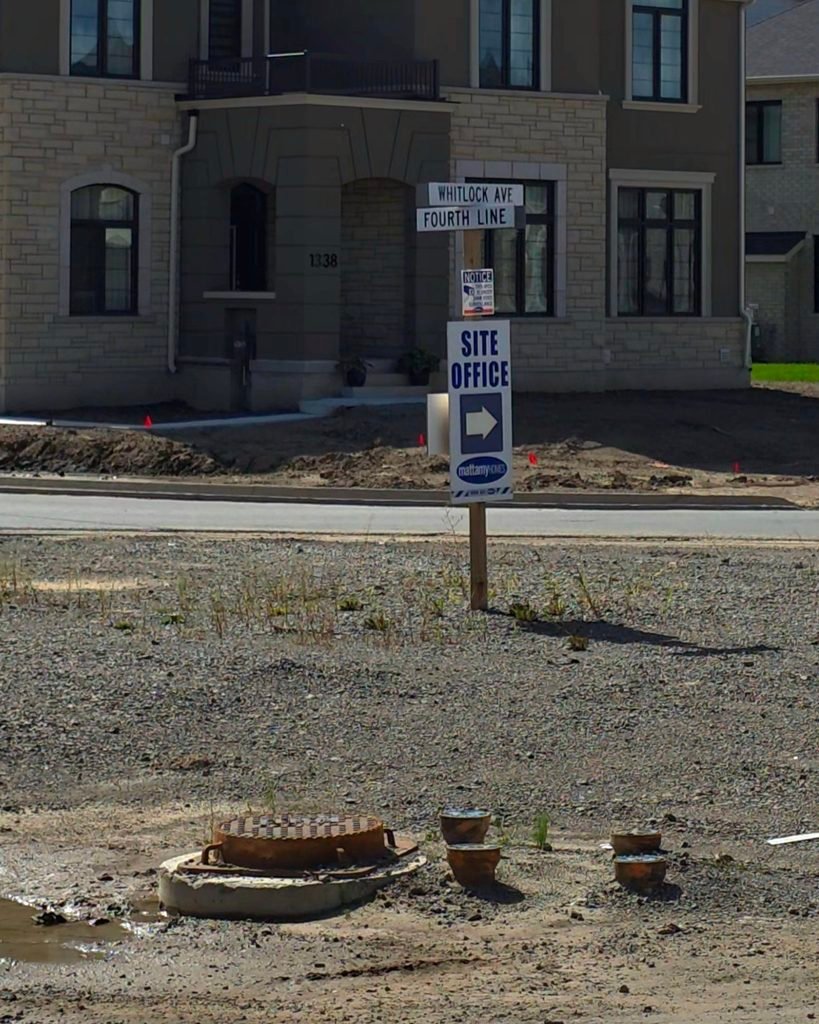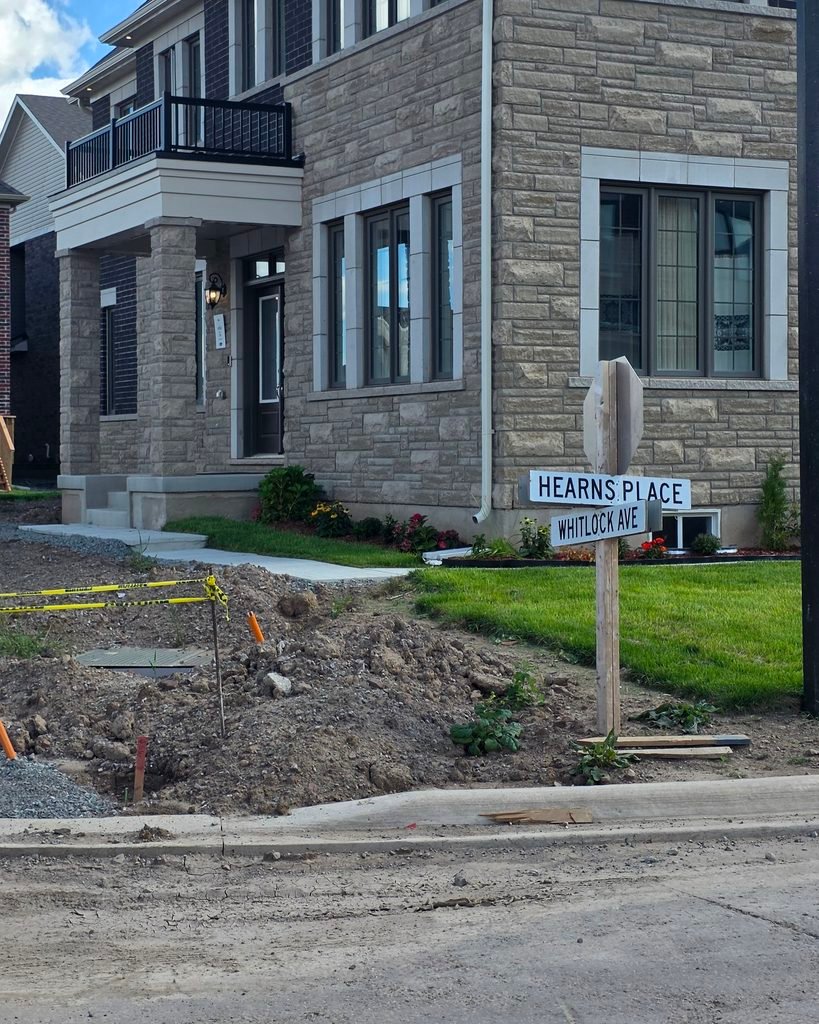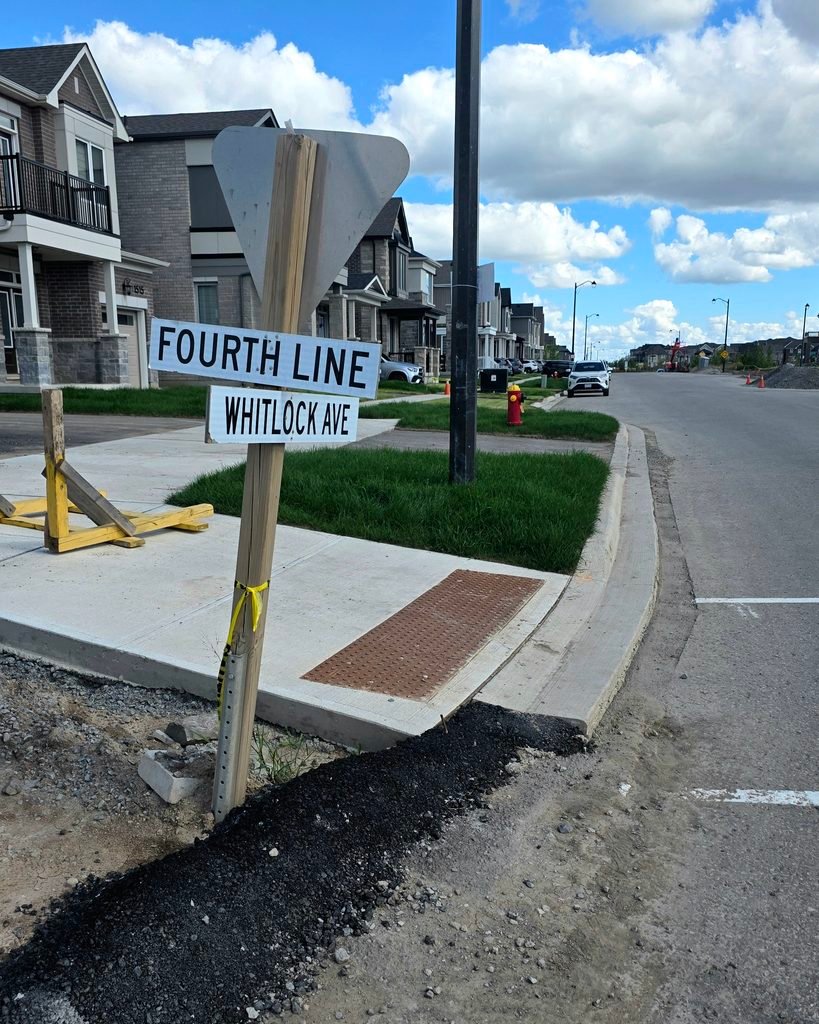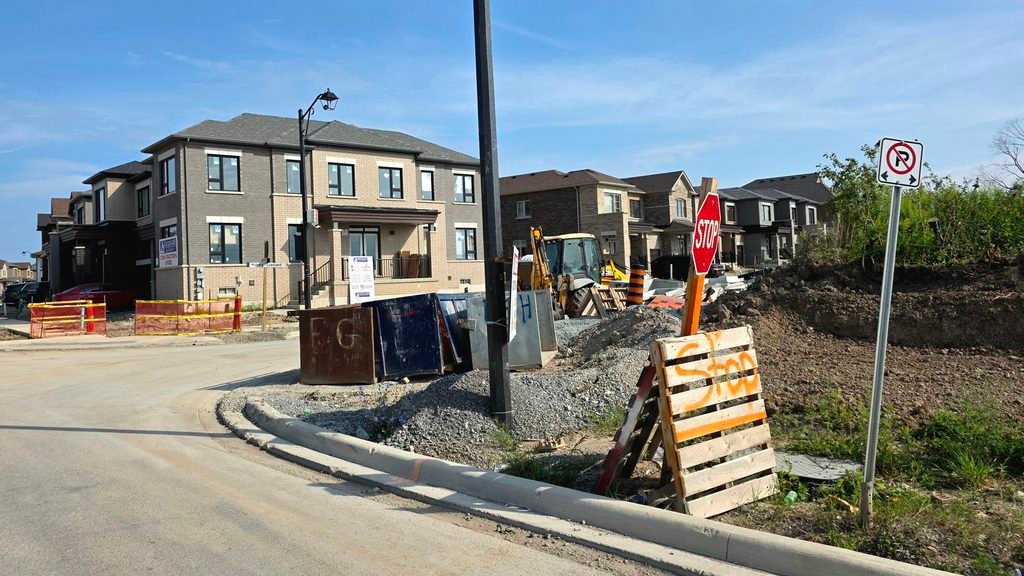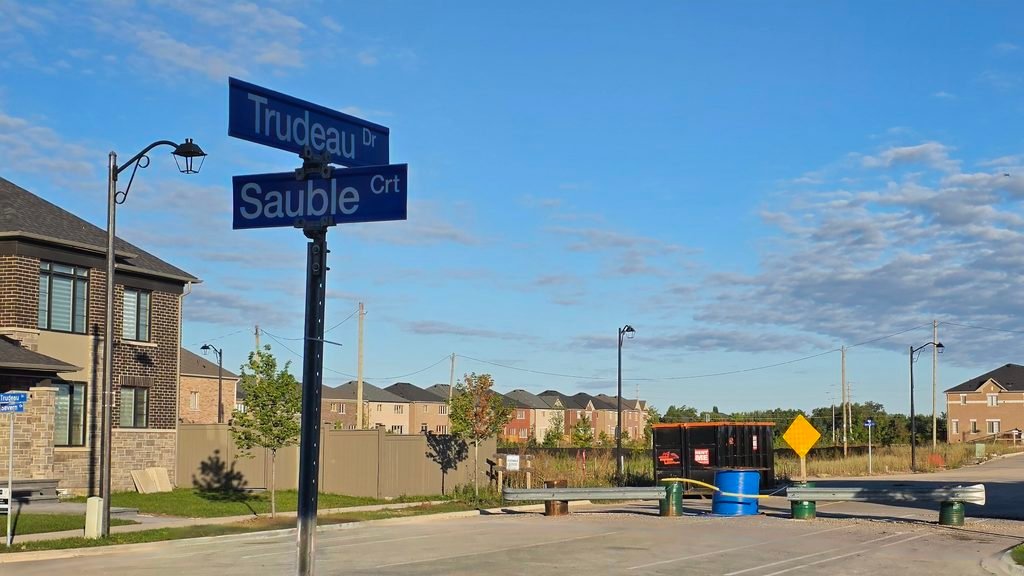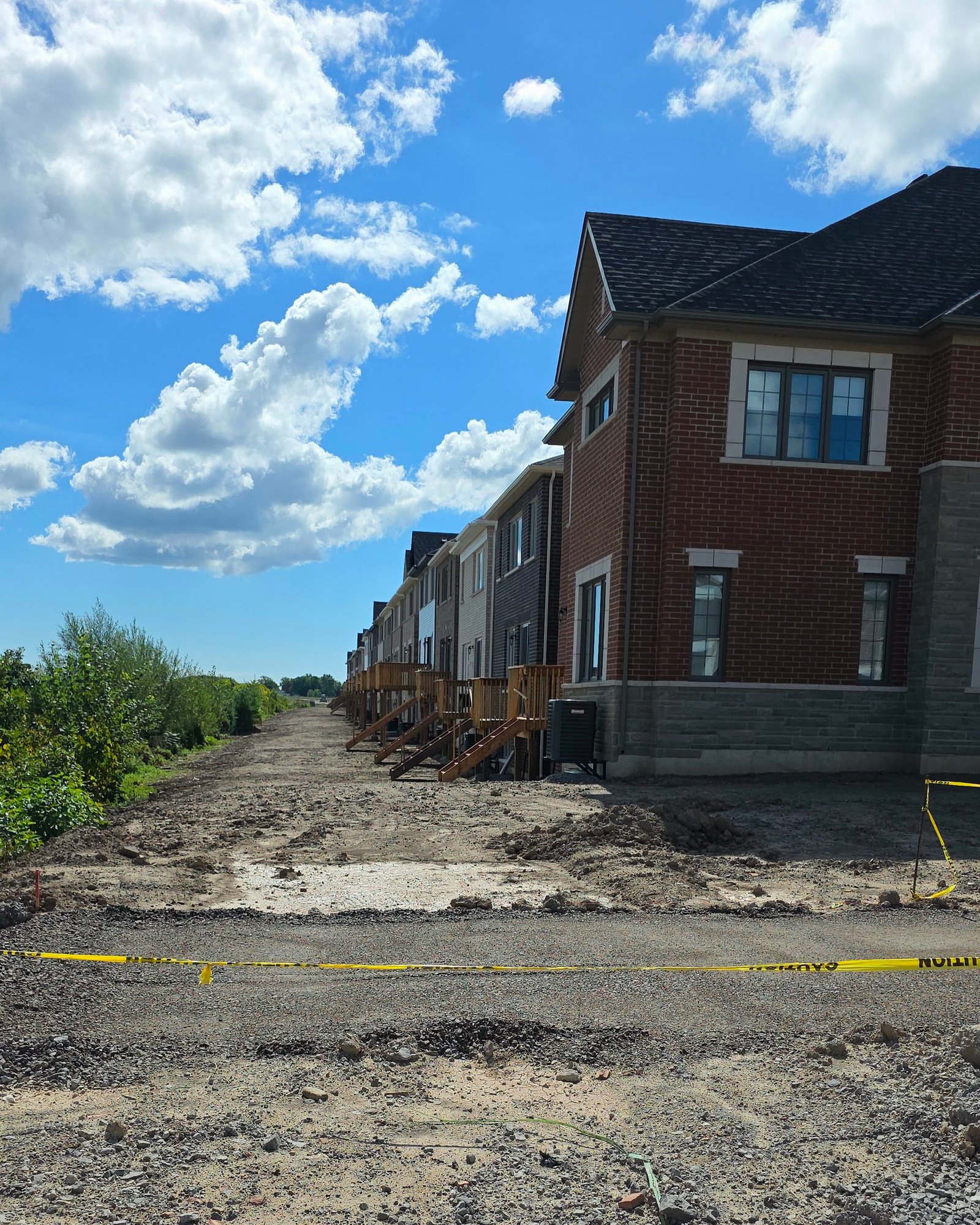
Milton is welcoming thousands of new residents every year. But a walk through some of our new subdivisions, like the corridors around Fourth Line and Whitlock Avenue, reveals a sobering reality.
Currently, families are receiving the keys to beautiful, newly built homes while the surrounding streetscapes remain active and hazardous construction zones for years. In municipal engineering, a “streetscape” includes the road surface and curbs, sidewalks and multi-use paths, boulevard grading and street trees, street lighting, benches, and public transit shelters.
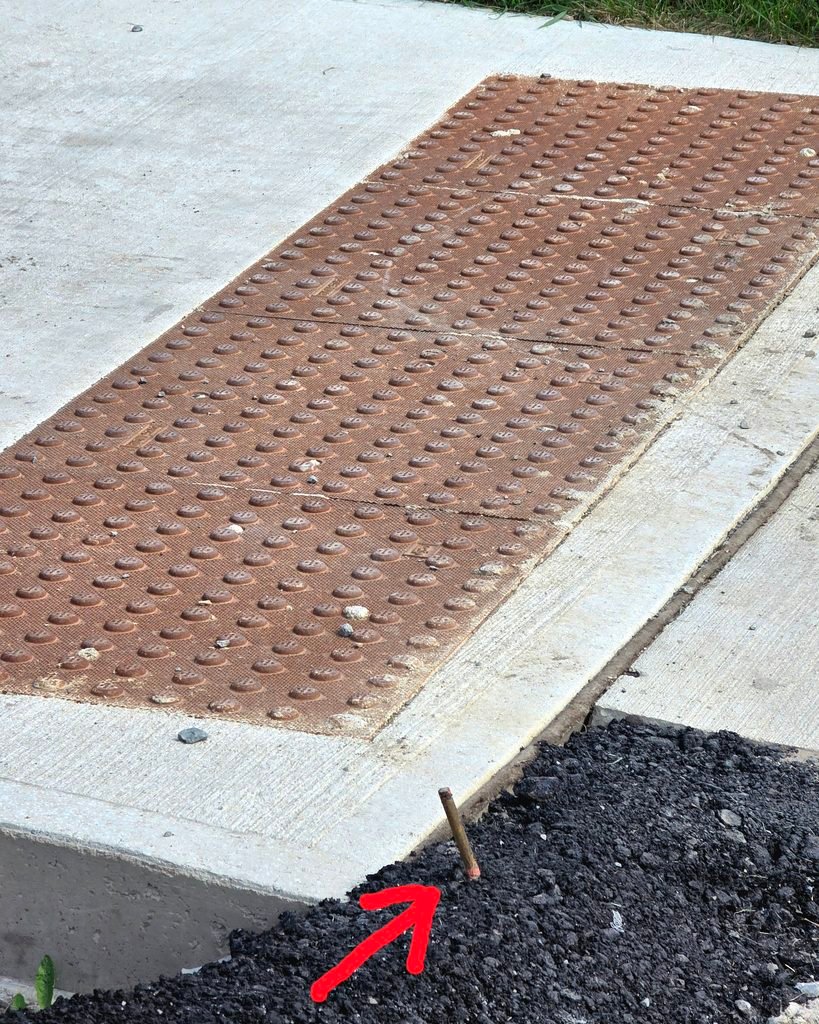
While introducing myself and interacting with residents in the Bowes neighbourhood last week, I noticed several deficiencies in public right-of-way assets, such as unfinished roundabouts and tactile pedestrian curb ramps that terminate abruptly into granular base materials with exposed survey pins.
Watch the quick video walkthrough of the corridors around Fourth Line and Whitlock Avenue
When a sidewalk ends abruptly at a gravel trench or dirt lot, a parent with a stroller or someone using a wheelchair has no choice but to divert onto the base-coat asphalt roadway to continue their route at their own risk.
This lack of finished infrastructure also creates significant challenges for our students. School bus routes in Milton are managed by Halton Student Transportation Services (HSTS). HSTS has strict safety protocols and will not route large yellow school buses into active construction sites, unassumed streets, or roads that lack proper, paved turning radii.
As a result, children living in these new subdivisions are assigned to “temporary” centralized bus stops, which are usually located out on the nearest assumed arterial road. To get to those stops, kids must walk through unfinished corridors, often without sidewalks, dodging trade vehicles and navigating raised manholes. This is not a safe environment for school-aged children.
This “infrastructure lag” is not simply a construction delay; it is a structural byproduct of how Ontario municipalities manage land development. Bridging this gap requires moving beyond generic campaign slogans to understand the legal, financial, and operational realities of land development in Ontario, and implementing practical policy levers at the Council table to resolve them.
Dismantling the Common Myths and Misconceptions
- Myth #1: The municipality is complacent and letting developers cut corners.
In Ontario, home construction and street construction are governed by two entirely separate laws. Under the Building Code Act, a municipality is legally required to issue an occupancy permit once an individual dwelling unit meets structural, fire, and health safety standards. The Town cannot legally withhold a family’s move-in permit to force a developer to finish the sidewalk outside. The public right-of-way, however, is governed separately under the Planning Act through municipal subdivision agreements.
- Myth #2: The Ontario New Home Warranties Plan Act will hold the builder accountable for any incomplete infrastructure.
The Ontario New Home Warranties Plan Act (administered by Tarion) strictly covers defects within your private property boundary (the dwelling and lot grading). It has zero legal jurisdiction over municipal right-of-way infrastructure. When residents submit warranty claims for missing sidewalks, unpaved streets, or damaged curbs, consumer protection bodies must turn them away because it falls outside their statutory mandate.
- Myth #3: Homeowners are paying full property taxes from day one.
When a buyer takes possession of a new home, the initial property tax bill typically reflects only the assessed value of the vacant land. The Municipal Property Assessment Corporation (MPAC) typically takes 12 to 24 months to conduct post-occupancy assessments. Once MPAC updates the property valuation to reflect the completed home, the municipality issues retroactive “supplementary” tax bills that can cover up to two years of backdated taxes. As a result, new homeowners face unexpected, lump-sum tax obligations while their neighbourhood infrastructure and amenities are still incomplete.
The average taxpayer does not know the difference between the Building Code Act (which governs occupancy) and the Planning Act (which governs municipal infrastructure assumption). They simply know they paid over a million dollars for a home and are paying thousands in property taxes to the Town of Milton, yet they do not have a finished street, completed sidewalks, or localized transit.
The Operational Reality of Assumption
The Town of Milton owns and manages our local roads. It dictates the standards in the subdivision agreement and intentionally delays official “assumption” (taking over maintenance and liability) so that heavy construction machinery doesn’t destroy the final infrastructure. While this financially protects the municipality from assuming damaged infrastructure and shifting premature replacement costs onto existing taxpayers, it forces new homeowners to live in unassumed, unsafe streetscapes for years.
However, this creates a major friction point due to the interdependency of the different infrastructure services we rely on. Halton Region manages our paramedics and waste collection, while the Town of Milton manages our fire services. Both Regional ambulances and Town fire trucks, as well as garbage trucks, require paved, clear roads with proper turning radii. When developers leave roads in a raw base-coat state or force residents to use dirt rear laneways, it directly impedes the ability of both the Town and the Region to safely deliver critical services.
The Incentive Disconnect: Explaining the Sudden Lack of Urgency Post-Closing
The multi-year delay in completing public infrastructure is not an accident; it is the structural result of misaligned financial and administrative incentives. The moment an occupancy permit is issued, the urgency to finish the surrounding streetscape drops sharply for nearly every stakeholder involved, leaving the homeowner to absorb the impact.
- Builders and Developers
The primary financial milestone is the homeowner’s closing date. Once title transfers and funds clear, the builder’s financial risk is reduced. As a result, crews and heavy equipment immediately shift focus to the next profitable phase of construction. Finishing the streetscape outside the home is often left as a low-priority task, handled only when it fits the builder’s schedule or when forced by municipal inspectors. - Commercial and Retail Banks
Commercial lenders finance developer projects, and those initial construction loans are paid off as soon as the homes are sold. Once the title transfers, retail banks step in to register residential mortgages and begin collecting interest. For these financial institutions, the physical state of the unfinished streetscape outside simply doesn’t factor into their risk models. Their investment is tied to the house, not the neighbourhood, meaning their capital is already secure. - Federal and Provincial Oversight
At the federal level, the Canada Mortgage and Housing Corporation (CMHC) assesses risk based on whether the individual home is livable and the mortgage is funded, while the Province measures municipal performance primarily through housing completion targets. Any delay in completing public right-of-way infrastructure is treated purely as a local administrative burden, leaving the residents to deal with the fallout. - Municipal Enforcement
Because the right-of-way remains the legal property and liability of the private developer prior to assumption, municipal enforcement often defaults to a reactive, complaint-driven model. Without routine, proactive site inspections, critical safety hazards such as exposed survey rebar, broken silt fences, or missing temporary curb ramps remain unaddressed until frustrated residents contact Town Hall.
Proposed Policy Levers: An Asset Management Approach
We need to go beyond pointing at issues during election season. We need leadership that understands exactly which policy levers to pull and what needs to be updated in the Town of Milton’s subdivision policies to protect our residents in the most cost-effective way.
- Mandatory, Safe Temporary Walkways
We must amend the Town’s Engineering Standards to require developers to install continuous, temporary multi-use asphalt paths during the early construction phases. Pedestrians should never be forced into live vehicular traffic. - Block-by-Block Completion and Assumption
We must stop allowing developers to leave multi-year construction phases open indefinitely. Subdivision agreements must mandate block-by-block completion. Construction of essential infrastructure (like making a roundabout fully drivable) must be completed before permits are issued for the next phase. This prevents residents in completed blocks from waiting years for distant phases of a master plan to be built. - Tying Developer Deposits to Safety Milestones
The Town holds millions in financial securities (Letters of Credit) from developers. We must restructure these financial guarantees so that funds are released in smaller, milestone-driven steps strictly tied to public safety and streetscape completion. This protects the Town’s financial safety net while maintaining developer liquidity, and it gives the Town the contractual authority to use those funds to immediately fix safety hazards if a developer fails to do so. - Paved Laneways Before Move-In
We must make base-coat asphalt and proper grading mandatory conditions before occupancy permits are granted for rear-lane townhomes. This eliminates impassable mud tracks and guarantees that Milton Fire, Halton Paramedics, and waste collection services have reliable year-round access from day one. - Developer-Funded Proactive Safety Inspections
We need to shift from a passive, complaint-driven model to scheduled safety and compliance inspections funded directly through developer engineering review fees. This adheres strictly to the principle of “growth paying for growth” and ensures active sites remain safe without burdening the existing taxpayers with the cost of enforcement.
Substance Over Political Slogans
The “infrastructure lag” is one of the clearest examples of what happens when policy fails to keep pace with growth. Unfinished roundabouts, missing sidewalks, and unpaved laneways are the direct result of an outdated operational framework that leaves accountability behind once home sales close.
By aligning subdivision agreements with asset lifecycle management and enforcing developer accountability, Milton can build complete, safe communities without risking fiscal sustainability.
The issues identified in this post are not unique to Milton. I experienced this firsthand while renting a home in a new subdivision in Bracebridge for a year during my employment with the District Municipality of Muskoka. My elderly neighbours, who had moved there seeking a better quality of life, would frequently reach out to ask if there was anything I could do in my role as a municipal employee to push the developer to complete any outstanding tasks.
That experience reinforced for me why we need engaged elected officials in leadership roles who are willing to proactively introduce policies to advance the best interests of the community.