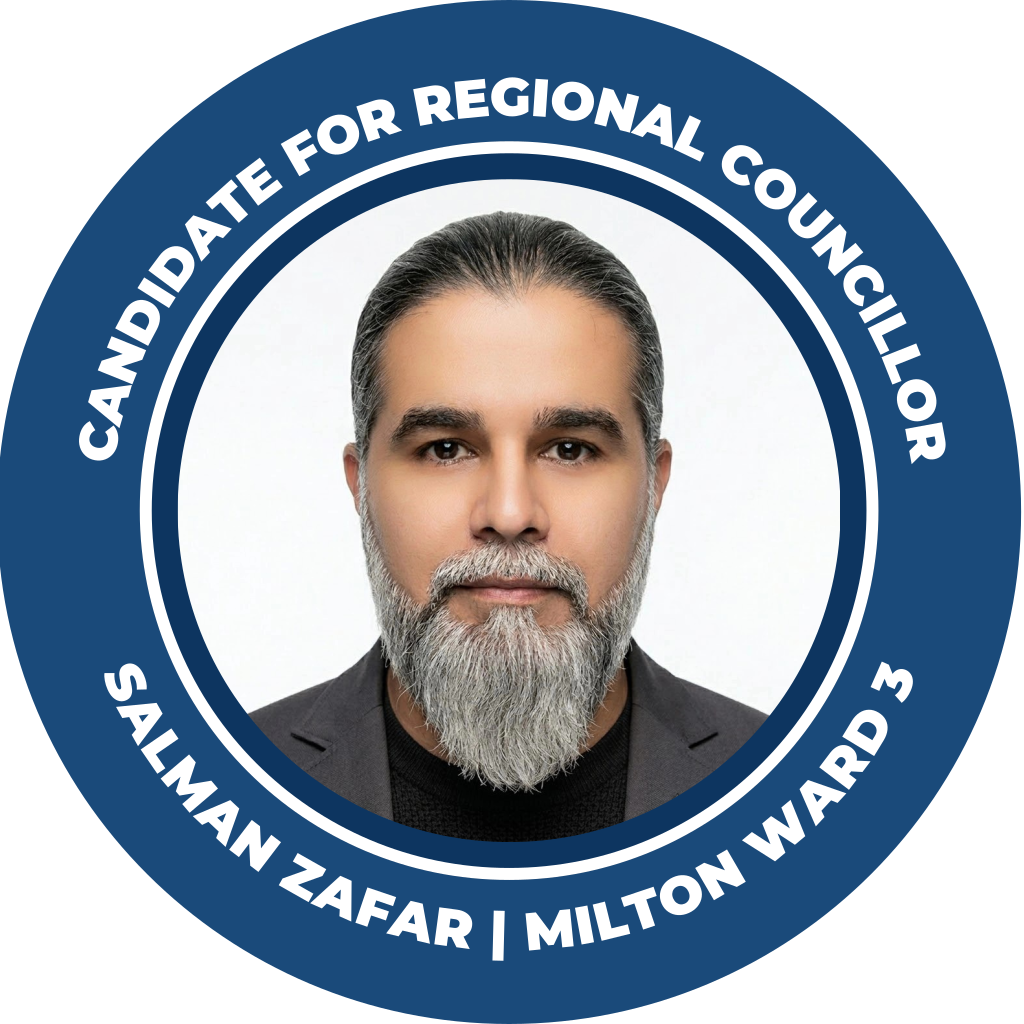
I recently had the opportunity to participate in the 2026 Municipal Election Candidates Survey organized by Sustainable Milton, a grassroots organization dedicated to community engagement, education, and climate advocacy.
Here are my responses:
1. Milton faces competing demands on its infrastructure budget (e.g. transit, roads, climate adaptation, parks) as well as other priorities like housing and youth engagement. In the context of making Milton a more environmentally sustainable community and working to achieve our climate goals, how would you make these kinds of investment decisions/ choices?
I approach competing municipal priorities through the lens of best practices in infrastructure asset management, prioritizing not just environmental sustainability, but also social and fiscal sustainability. My perspective is shaped by professional certifications in asset management from globally recognized organizations like IPWEA and the IAM, alongside specialized credentials in climate change adaptation from the Waterloo Climate Institute. Having recently developed Corporate Asset Management Plans as municipal staff for both Halton Region and the District Municipality of Muskoka, I am proficient in leveraging risk-based infrastructure investment strategies to balance the cost of climate adaptation with long-term financial sustainability.
We must move away from the outdated “like-for-like” replacement standard. Instead, I advocate for embedding a “Climate Lens” directly into Council’s decision-making framework. By measuring the whole lifecycle costs of asset deterioration caused by climate hazards, we ensure that sustainable, resilient investments compete fairly alongside deceivingly cheaper options that offer low upfront costs but carry severe, long-term financial implications for local governments.
2. Climate change is expected to increase the frequency and severity of extreme weather events. What do you think Milton needs in order to help residents prepare for extreme weather events such as flooding, storms, extreme heat, and wildfire smoke?
As a municipal infrastructure asset management practitioner, proactively investing to make our infrastructure resilient to extreme weather is not a political talking point. It is strictly about managing risks to service delivery. For example, ensuring municipal stormwater pipes are engineered to handle heavier rainfalls prevents roads from washing out and homeowners from facing flooded basements. Ultimately, it is about protecting municipal assets to avoid catastrophic, unplanned replacement costs funded by local taxpayers. While the causes of extreme weather may not be fully in our control, we can absolutely decide how we respond to it.
During the recent extreme rain events in the Niagara Region, there was severe, historic flooding, washing out roads, overwhelming stormwater infrastructure, and causing an estimated $360 million in damages. A state of emergency was even declared in some areas like the Town of Lincoln. My municipal colleagues in paramedic services shared an incident of an ambulance getting stuck on a flooded road while transporting a patient to the ER. This is a classic example of the interdependency of municipal infrastructure services, where we need to see the system as a whole, not in isolation.
The choice before Council is simple: we can either proactively adapt our infrastructure and save long-term costs, or continue a reactive approach that is highly disruptive to residents and rapidly depletes our municipal reserves.
To prepare Milton, we must invest in developing a comprehensive climate change adaptation plan, anchored by a detailed climate hazard vulnerability assessment of all local infrastructure assets. Based on those verified results, I will prioritize enhancing the environmental resiliency of our most critical, high-risk assets first. This will prevent them from failing during extreme weather events and guarantee the reliable delivery of our municipal services without interruption.
3. The Town of Milton is a member of the Partners for Climate Protection, (PCP) a program of the Federation of Canadian Municipalities. The goal of the program is to reduce green house gas emissions. It sets out five milestones for municipalities: create a baseline emissions inventory; set emissions reductions targets; develop and implement a local climate action plan; monitor and report results. As a member of Council, what will you do to ensure the Town achieves the PCP milestones and reduces its green house gas emissions?
Achieving the Partners for Climate Protection milestones requires treating sustainability as a core financial metric. I am proud that Halton Region has successfully completed all five milestones of the PCP program, a framework I formally integrated into the Region’s 2025 Asset Management Plan as a former employee of Halton Region. To fund these reduction milestones without overburdening the tax levy, I advocate for embedding climate mitigation directly into asset lifecycles, such as installing solar photovoltaic panels during scheduled roof replacements and integrating micro-hydro turbines at wastewater treatment plants.
Furthermore, having relevant experience as a Peer Reviewer of municipal funding applications and as an Evaluation Committee Member for Partnership Grants for FCM’s Local Leadership for Climate Adaptation initiative, I am looking forward to providing required oversight to Milton staff to develop “investment-ready” business cases to secure external federal and provincial capital for our Town.
4. How will you improve service reliability, frequency and affordability of Milton transit so it offers an attractive town-wide alternative to private car use?
To build an attractive alternative to private automobile use, I am committed to working toward a 20% transit mode share to systematically reduce peak-hour gridlock. To achieve this target, I will enforce a municipal policy that conditions new subdivision and secondary plan approvals on actual, verified road and transit network capacity. Growth must never outpace our infrastructure, which will prevent transit routes from being bogged down by traffic congestion.
I will also restructure routes around high-density transit nodes to provide direct, seamless connections to major employment corridors, schools, Milton District Hospital, and places of worship. Aligning transit routes with regional hubs will connect Milton effectively into the broader Halton and GO Transit networks.
I am also committed to providing free transit for Milton seniors. Municipal transit revenue is primarily generated by peak-hour commuters and student passes. Seniors predominantly travel during off-peak hours when buses operate with surplus seat capacity. Integrating seniors onto existing, half-empty routes incurs near-zero marginal operating cost, requiring no additional buses, driver hours, or fuel expenditure, while substantially reducing isolation and supporting social mobility.
5. Studies show that the construction of Highway 413 will destroy wetlands and other vital wildlife habitat and will impact already endangered species. In the context of these environmental harms, what is your position on the proposed Highway 413?
Large-scale infrastructure projects must be evaluated strictly on their lifecycle costs, risks to service delivery, and environmental impact. Building infrastructure that destroys wetlands creates a macroeconomic drag because natural assets act as critical, free stormwater management systems. When we pave over these natural ecosystems, the municipality is eventually forced to build, maintain, and inevitably replace expensive, engineered stormwater infrastructure to prevent local flooding.
As a Regional Councillor, I will ensure that any regional consultation regarding Highway 413 rigorously quantifies these environmental externalities and long-term adaptation costs.
If the verified data shows that the project jeopardizes our local natural assets and increases municipal financial vulnerability to extreme weather events, I will not support it.
6. Many local municipalities are being encouraged to attract large AI data centres as a source of economic development and job creation. Job creation is a key priority of Council in permitting industrial development in Milton. However, large data centres deliver very few good jobs, but require significant amounts of land, water, and electricity, resulting in substantial environmental impacts. If an application for a large data centre were to come before Council, what actions would you endorse to ensure no adverse environmental impact?
From an infrastructure perspective, my primary concern is the impact of large-scale data centres on municipal utilities. These facilities require immense amounts of electricity and a dedicated water supply for cooling systems, and they generate localized noise and vibration that can impact nearby communities and natural ecosystems.
I strongly support the proactive strategy recently taken by the Town of Oakville to implement a one-year pause on the development of new data centres. This allows the municipality the necessary time to update Official Plan policies and zoning regulations, ensuring we fully understand the impact on local hydro and municipal infrastructure before any building permits are issued.
We must also evaluate whether our prime employment lands are better reserved for knowledge-based employers who bring a higher volume of jobs. I will not support rubber-stamping these applications without verified data.
7. Please feel free to share anything else that you would like voters to know about your environmental platform or priorities.
To the voters of Milton, my message is quite straightforward. Environmental stewardship and fiscal responsibility are not competing municipal priorities. They are basically the same thing. I have built my career on the principle that climate action cannot be treated as an ideological buzzword or an isolated environmental initiative. It must be executed as a core infrastructure and financial risk management strategy.
When we fail to adapt our infrastructure to extreme weather, we are unintentionally causing a cycle of costly, reactive emergency repairs that drain our municipal reserves and drive up local property taxes.
If elected, I will bypass superficial photo-ops and projects that lack a verified, data-driven business case. I will ensure every environmental policy we pass directly protects Milton’s natural assets, defends our critical infrastructure from climate hazards, and secures the long-term financial, social and environmental sustainability of our community.
To view the official survey page and compare responses from all candidates, visit Sustainable Milton’s website here:
https://sustainablemilton.ca/candidate-survey