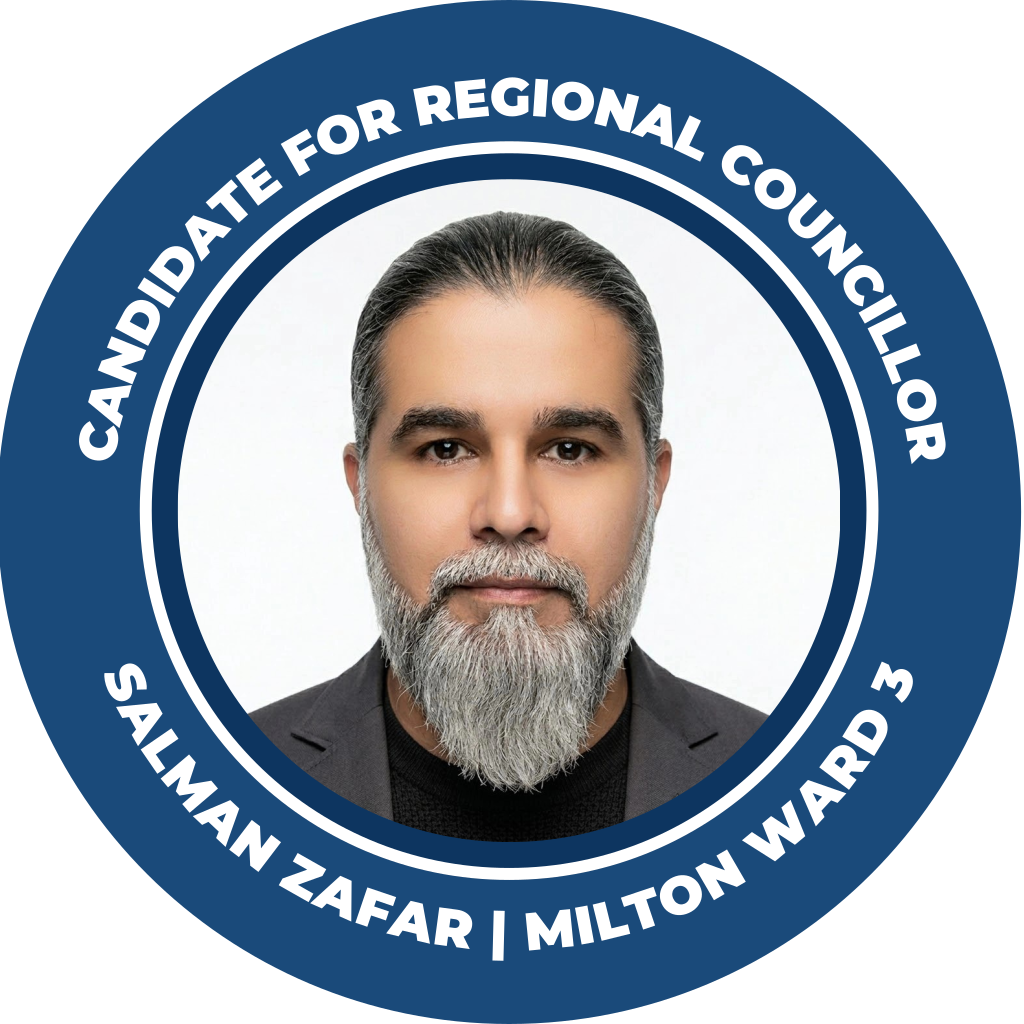
Tune in or join in person this Wednesday, June 17, 2026, at 9:30 a.m. for the upcoming Regional Council meeting.
 Date: Wednesday, June 17
 Time: 9:30 a.m.
 Location: Halton Regional Centre, 1151 Bronte Road, Oakville
 Meeting Agenda: https://edmweb.halton.ca/OnBaseAg…/Meetings/ViewMeeting…
Under the Municipal Act, 2001, Ontario municipal councils are required to publish agendas and hold open meetings to ensure a reliable paper trail for public funds and enable citizen participation. However, the effectiveness of this system is all too often hindered by dense technical language and short notice periods. While the system is designed to foster democratic accountability of municipal Councils, its true success depends entirely on active community engagement.
To demonstrate the kind of proactive engagement, education, and consultation you can expect from me if elected, here is a plain-language breakdown of the key items on the June 17 agenda. Halton Region staff have prepared these detailed reports for Council’s review and published them upfront so that you have full visibility into the choices shaping our community.
HOW WE WILL TURN THIS INFORMATION INTO ACTION:
Sharing this plain-language breakdown is just the first step in a two-way conversation. If elected, my goal is to host regular “Pre-Council Coffee Chats” right here in Milton before major meetings. These informal drop-in sessions will give us a chance to review upcoming agenda items face-to-face, discuss complex infrastructure or financial decisions, and ensure your feedback is actively brought to the table.
 DEVELOPMENT CHARGE REDUCTION PROGRAM (DCRP): Halton Region staff have provided a detailed assessment of a new federal-provincial infrastructure funding program. Regional Council will evaluate whether to participate, weighing the need to build infrastructure for new homes against the long-term fiscal impact on local property taxpayers and utility rate bases.
 The DCRP Opportunity: The DCRP is an $8.8 billion capital fund designed to help municipalities build housing-enabling infrastructure. Under the program, up to 90% of eligible project costs may be funded by the Federal and Provincial governments, with municipalities required to contribute a minimum of 10%.
DCRP Qualification Criteria & Timing: To qualify, the Region must agree to reduce residential development charges by 30% to 50%. Depending on the reduction chosen, Halton’s funding request could range from approximately $200 million to $420 million. The application deadline is June 19, 2026. If approved, the Region would be required to maintain the development charge reduction for a period of three years.
What DCRP Means for Taxpayers: Unlocking this funding requires the Region to fund at least 10% of the project costs ($20 million to $42 million) from non-development sources, effectively shifting some growth-related costs to existing ratepayers. To protect ratepayers, staff have identified mitigation strategies like phased debt and reserve draws to minimize annual impacts. Additionally, because the Province can adjust funding if developments do not proceed in a timely manner, staff recommend safeguards: developers must meet defined occupancy timelines (2 years for low/medium-density, 4 years for high-density) to retain the discount.
DCRP Benefits & Targeted Projects: If successful, this funding will directly support three eligible infrastructure projects: the Lower Base Line Wastewater Pumping Station, the Mid-Halton Wastewater Treatment Plant Expansion, and the Burloak Water Treatment Expansion. Securing senior government funding for these projects is an important step to safely expand system capacity in alignment with local municipal growth targets.
ALLENDALE CAMPUS MASTER PLAN: Halton Region staff recommend that Regional Council authorize staff to engage private and not-for-profit organizations to explore alternative partnership, ownership, and funding models to accelerate the $150 million Phase 1 development in Milton. Exploring these partnerships is intended to help unlock and accelerate the site’s development potential.
NEW SUPPORTIVE HOUSING INVESTMENT: Regional Council will consider a staff recommendation to approve a new $13.5 million capital project financed from the Housing – New Units Reserve to support a 55-year partnership with Indwell for 77 new supportive housing units on Waterdown Road in Burlington. This provides purpose-built housing with integrated health and life-skills supports to help residents live independently.
HOMELESSNESS PREVENTION PROGRAM (HPP): Staff seek approval for a $14.3 million investment plan to fund emergency shelters, supportive housing, and community outreach for 2026-2027. This maintains front-line services that have seen a 14% increase in overall emergency shelter demand this past year.
COMMUNITY HOUSING INITIATIVES: Staff recommend an investment plan of $7.9 million under the Canada-Ontario Community Housing Initiative and Ontario Priorities Housing Initiative to create 55 new assisted housing units and support capital repairs. Preserving existing units through capital repairs maintains housing affordability as buildings age.
HOUSING STRATEGY PROGRESS: The 2025 Comprehensive Housing Strategy annual update shows progress, including the creation of 102 new assisted housing units and the prevention of 581 evictions through targeted supports. These housing loss prevention supports help households maintain housing and avoid eviction.
ASSET MANAGEMENT PROGRAM: The annual review by staff confirms that Halton Region remains in compliance with provincial regulations, maintaining over 80% of its infrastructure assets in good or very good condition. Regular assessment and maintenance ensure necessary repair and renewal needs are met to support reliable services.
GROWTH AND ALLOCATION POLICIES: Staff propose delaying final development charge payments until the occupancy stage to ease financial pressures on builders. This flexibility helps developers manage their capital more effectively, which can accelerate the construction of much-needed homes. Additionally, the 2026 Enhanced Growth Monitoring report confirms that Halton currently has sufficient water and wastewater capacity to fully support local municipal housing pledges through 2031.
TRANSIT & CORRIDOR IMPROVEMENTS: Memos from Public Works highlight completed Environmental Assessment (EA) studies for road widening on Regional Road 25 and James Snow Parkway, alongside the fall 2026 launch of new EA studies for the North Aldershot Reservoir and the Central Booster Pumping Station. Completing these environmental studies is an approved process under Ontario’s Environmental Assessment Act prior to detailed design and construction.
SOURCE WATER PROTECTION PLAN: Staff recommend endorsing amendments to the Halton-Hamilton Source Protection Plan to reflect a new replacement well for the Campbellville drinking water system and the decommissioning of the Walkers Line wellfield. Updating these plans ensures regulatory frameworks remain effective and responsive to changing conditions to safeguard municipal drinking water.
2027 BUDGET PROJECTIONS: In preparation for the 2027 budget process, staff have provided updated budgetary projections and outlooks based on identified pressures in Regional programs. Over the coming months, staff will focus on maintaining core services, continuous improvement, and finding cost efficiencies to mitigate impacts.
Regional Services Tax Impact: The updated projected 2027 property tax increase for Regional Services is 4.0% after assessment growth of 1.9%. The projection reflects an inflationary increase of 3.0%, plus an additional 1.0% projected to address cost pressures related to new waste management contracts, sustained call volume growth in Paramedic Services, and additional investments in Health and Social Services.
Combined Tax Impact: The combined projected 2027 property tax impact for Regional Services and Police Services is 5.4%, which is comprised of a projected increase of 4.0% for Regional Services and 7.4% for Police Services after assessment growth of 1.9%.
Water and Wastewater Rates: The projected 2027 water and wastewater rate increase remains at 5.5%, which is comprised of 3.0% capital financing to support the State-of-Good-Repair program, 2.0% to operate and maintain the system, and a 0.5% investment in the enhanced Basement Flooding Mitigation Program.
PARAMEDIC SERVICES PRESSURES: To address compensation pressures driven by a 10% increase in call volumes, staff recommend increasing the 2026 operating budget by $2.3 million, funded through a transfer from the Tax Stabilization Reserve. This adjustment addresses compensation and service pressures beyond the level anticipated in the 2026 Budget to maintain service levels.
WASTE MANAGEMENT: The 2025 year-end report highlights a 3% decrease in solid waste managed by the Region, largely due to the Blue Box program transitioning to full producer responsibility. This transition shifts the responsibility for managing unacceptable and contaminated Blue Box material to Circular Materials Ontario.
ACCESSIBILITY PLAN UPDATE: As required by the Integrated Accessibility Standards, staff have completed and posted the 2025 update to Halton Region’s Accessibility Plan (2024-2028). This update tracks mandatory compliance actions and highlights additional Halton-led initiatives aimed at removing barriers for people with disabilities across customer service, information and communications, employment, and the design of public spaces. The report is available on the Halton Region website and will be provided in alternate formats upon request.
YOUR VOICE IS CRITICAL TO THE FUTURE OF MILTON AND HALTON REGION!
I encourage you to review the agenda, watch the live stream, or attend the Regional Council meeting in person this Wednesday to see exactly how these choices are being made.
Let’s build a stronger, more transparent community together!