The legal battle over the CN Logistics Hub is over. The Supreme Court of Canada’s May 2025 decision closed the final appeal, ending a major court battle that cost local taxpayers over $30 million. We may no longer control whether the hub exists, but we absolutely can control how rigorously its impacts are monitored, enforced, and paid for. Our focus must shift from trying to stop the approval to ensuring the project is rigorously monitored and that every enforceable condition is respected.
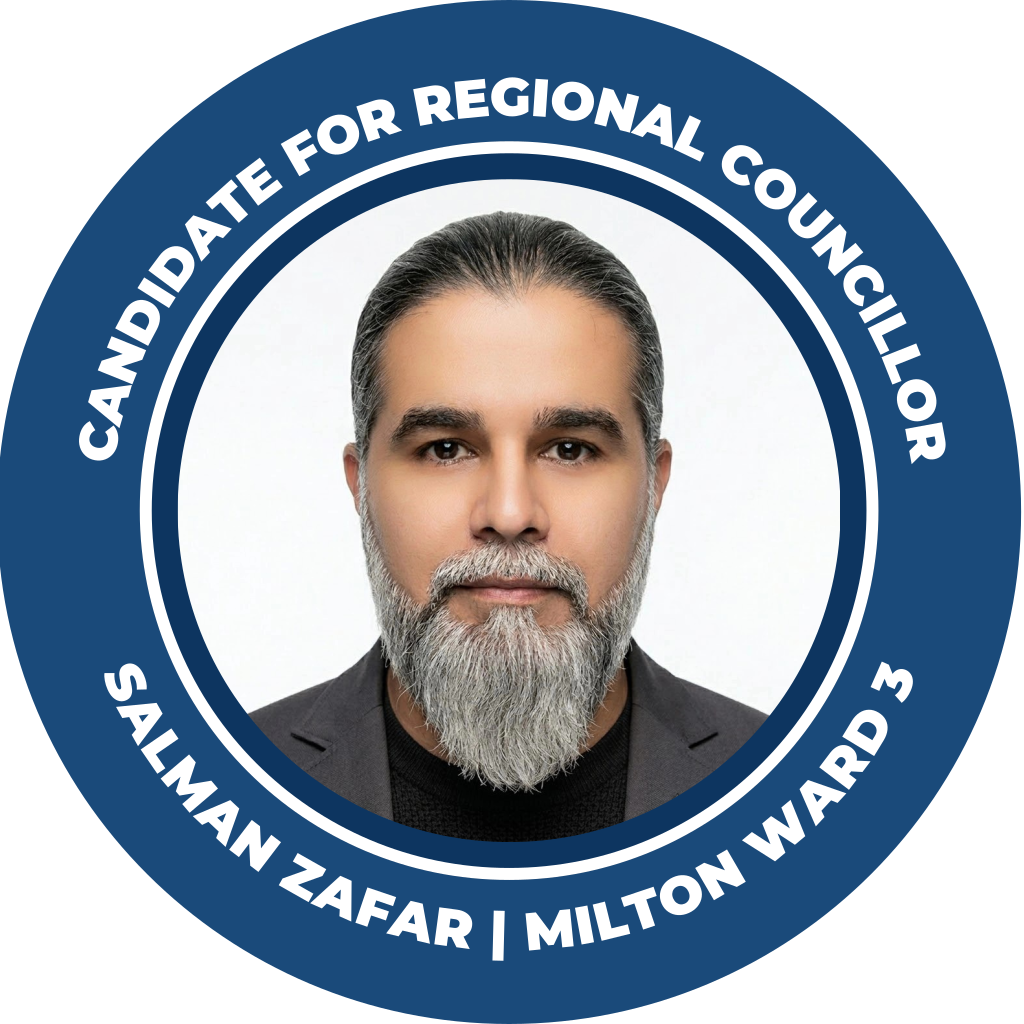
Drawing on my experience as a municipal practitioner researching and advancing best practices in infrastructure asset management across Ontario, I would like to share my proposed approach as your candidate for the Regional Councillor position. This plan is strictly aligned with my core principles (substance over visibility, evidence over populism, long-term responsibility) and my accountability framework:
1. Traffic Management
The hub is projected to generate up to 1,600 heavy-duty truck trips daily. To manage this safely, we must take a two-step approach: building the right infrastructure and enforcing strict routing.
First, I will push Halton Region to implement dedicated truck lanes on the Britannia and Tremaine corridors to physically separate commercial freight from residential traffic.
Second, because a local municipality cannot legally force commercial traffic into a provincial toll booth on Highway 407 under the Municipal Act, we must ensure trucks actually use these dedicated corridors. I will advocate for strict municipal Heavy Truck Route By-laws that legally prohibit transport trucks from cutting through residential areas along James Snow Parkway, directing them strictly toward highway connections.
Furthermore, I will demand a combined traffic and environmental study measuring the combined impact of the CN Hub and the proposed “Milton Link” expansion on our traffic grid before any further planning approvals, such as Official Plan amendments or rezoning, are granted.
2. Public Safety
Adding 1,600 daily transport trucks to our local grid is a critical public safety issue. This is particularly alarming in light of the May 2026 Auditor General report detailing severe systemic failures in Ontario’s commercial truck driver training. The report exposed shared oversight failures between the Ministry of Colleges and Universities (MCU) and the Ministry of Transportation (MTO). Specifically, the Auditor General faulted the MCU for failing to ever inspect 25% of the province’s private truck training schools and completely ignoring more than half of the schools due for their mandatory 5-year re-inspection. Due to these fraudulent training shortcuts and severe oversight gaps, underprepared drivers are routinely on our highways. While large trucks account for only 3% of vehicles, they are involved in 12% of fatal collisions.
This massive influx of heavy freight will place a severe strain on the Halton Regional Police Service (HRPS) Commercial Motor Vehicle Enforcement Unit to conduct necessary safety blitzes, monitor route compliance, and respond to collisions. This enforcement burden must not come at the expense of our community policing resources, which are needed to keep us safe from organized property crime and auto theft. We must ensure the logistics ecosystem pays for the oversight it requires.
I will push for targeted cost-recovery business licensing for logistics operators, aggressive Development Charges for adjacent warehousing projects, and strict Heavy Truck Route by-law fines to perpetually fund dedicated HRPS commercial traffic enforcement.
3. Environmental Accountability
While the federal government argues this facility will meet the rising demand for goods movement and lower overall regional emissions by shifting long-haul freight to rail, the localized health impacts are simply unacceptable. The federal Review Panel confirmed risks regarding diesel emissions near approximately 40,000 residents and 12 local schools.
This exposes a stark lack of coordination between our levels of government. The provincial government is mandating Milton to rapidly build thousands of new homes to meet aggressive housing targets. Simultaneously, the federal government, despite its own mandate to achieve net-zero greenhouse gas emissions by 2050, has approved a diesel-intensive freight facility right beside these expanding neighbourhoods. Why would families invest in these mandated growth areas if their air quality is fundamentally compromised?
If countries like Norway can mandate fully electrified, zero-emission freight terminals, Milton should not accept an outdated diesel operation. As your Regional Councillor, I will ensure that the 325 legally binding conditions attached to the federal approval are strictly enforced to push CN toward battery-electric equipment, anti-idling bylaws for queuing trucks, and the planting of dense vegetative buffers along the Tremaine and Britannia corridors to actively reduce exposure to roadside dust and particulate pollution.
4. Fiscal Responsibility
Because CN operates under federal jurisdiction, they bypass standard municipal Development Charges and property taxes, leaving us with a tax shortfall of approximately $7 million annually. We must use total lifecycle costing models to precisely measure the physical wear and tear these trucks will cause to our road network, which leads to accelerated deterioration and increased asset lifecycle costs (operations, maintenance, resurfacing, and reconstruction).
We cannot raise local property taxes in the future to subsidize federal logistics operations. Aggressively advocating for a dedicated 1% share of the existing HST to be earmarked exclusively for keeping local infrastructure in one of Canada’s fastest-growing municipalities in a state of good repair, backed by reliable, transparent lifecycle data, is a far more cost-effective and pragmatic option for managing this hub.
It is a much stronger path forward than continuing to spend millions of taxpayer dollars on legal battles where the system is inherently stacked against us, utilizing constitutional rules like “interjurisdictional immunity” designed to shield federal corporations from paying their fair share of municipal taxes and development costs.
5. Regulatory Transparency
Enforcing federal compliance requires rigorous technical oversight. The federal Decision Statement legally limits the project to no more than 450,000 containers handled per calendar year and caps trucks entering the site to a daily average of 800 per month. It also mandates a third-party independent environmental monitor, particularly for construction-related compliance.
I will ensure the Region actively audits CN’s compliance reports and uses every available municipal and regional enforcement mechanism. Crucially, I will advocate for all air quality, noise, and traffic data to be translated into plain language and published on a public dashboard in collaboration with community watchdogs like Halton Community Impact Watch.
There will be no compromise on transparency.
We cannot alter past court decisions, but we can completely control how the Town of Milton and Halton Region respond to advance the best interests of our community.